
Wills, living trusts, powers of attorney, healthcare directives. We’ll build a complete plan that protects your family, avoids probate, and honors your wishes.
Most Texas families know they need an estate plan. They just haven’t done it yet. Maybe it feels complicated. Maybe it means thinking about things nobody wants to think about. We get it and we’ve spent 20 years making this process as simple and painless as possible.
Estate planning isn’t just about distributing your assets it’s about protecting your family’s financial security, upholding your values, and ensuring your wishes are honored exactly as you intend them. For nearly 20 years, our attorneys have guided families and individuals through the estate planning process with compassion and expertise.
We understand that every family’s situation is unique. That’s why we don’t believe in one-size-fits-all solutions. Whether you’re just beginning your planning journey, updating an existing estate plan, or navigating complex family dynamics, our team works with you to create a tailored strategy that fits your needs and budget.
Our approach ensures:
A revocable living trust is the cornerstone of a strong estate plan. Unlike a will, it keeps your affairs private, avoids probate delays, and ensures seamless control if you become incapacitated.
Key benefits:
Setting up a revocable living trust is straightforward and gives you complete control:
Thomas D. Fortenberry has helped Texas families protect their legacies for over 20 years.
Not true. Estate planning isn’t just for rich people. If you own a house, have a 401(k), or have kids, you need a plan. Without one, your family could end up in probate court spending thousands of dollars and months of time just to get access to your accounts. And if you’ve got minor children, the court gets to decide who raises them if you haven’t named a guardian. That’s not a risk you want to take.
A will is better than nothing, but it’s not enough for most families. Wills have to go through probate, which means your family has to hire a lawyer, go to court, and wait months before anything gets distributed. A revocable living trust avoids all of that. Your family gets immediate access to your assets without probate, without a judge, and without making your private affairs public record.
Estate planning isn’t about age it’s about responsibility. If you’ve got a spouse, kids, or assets, you need a plan. I’ve seen 30-year-olds die in car accidents. I’ve seen healthy 40-year-olds have strokes. Life doesn’t wait until you’re ready. The question isn’t if something will happen it’s when. And when it does, will your family be protected?
Probate is the legal process where the court oversees the distribution of your assets after you die. In Texas, probate isn’t as bad as it is in some states, but it’s still expensive, time-consuming, and public. Your family has to hire a lawyer, file an application with the court, wait for a hearing, and then follow the court’s rules for distributing your assets. The whole process typically takes 4 to 8 months and costs $5,000 to $10,000 or more. With a trust, your family skips probate entirely. A revocable living trust avoids all of that. You transfer your assets into the trust while you’re alive, and when you die, your successor trustee distributes everything according to your wishes. No court, no delays, no public record. It’s faster, cheaper, and more private.
If you die without a plan, the Texas Legislature has one for you. It’s called the Texas Estates Code, and it decides who gets your stuff and who’s in charge of distributing it. For most families, that means your spouse and kids will co-own your property, even if that’s not what you wanted. And if you’ve got minor children, the court gets to decide who raises them. Is that really what you want?
Yes. Trusts aren’t just for rich people. If you own a house, have a 401(k), or want to avoid probate for your family, a trust makes sense. The cost of probate in Texas is typically $5,000 to $10,000. A trust costs less than that and saves your family the hassle of dealing with the court system. Plus, a trust gives you more control over how and when your assets are distributed.
A will is a document that tells the probate court how you want your assets distributed after you die. The problem? It has to go through probate, which means your family has to hire a lawyer, go to court, and wait months before anything gets distributed. Your will also becomes public record, so anyone can look up what you owned and who got what. A revocable living trust avoids all of that. You transfer your assets into the trust while you’re alive, and when you die, your successor trustee distributes everything according to your wishes—no court, no delays, no public record. It’s faster, cheaper, and more private.
You can, but I wouldn’t recommend it. I see DIY wills and online documents in my office every month, and most of them are missing critical language that makes them worthless in Texas. For example, if your will doesn’t name an independent executor, your family is stuck in dependent probate, which costs twice as much and takes twice as long. I’ve also seen families lose out on tens of thousands of dollars because their online will didn’t include the right provisions. A good estate plan is worth doing right the first time.
Powers of attorney are some of the most overlooked, and most important, documents in your estate plan. They don’t do anything after you die. They work while you’re alive but can’t make decisions for yourself.
You need two kinds in Texas:
Without these, your family could be forced into a guardianship, which costs $5,000+ up front and keeps costing money until you die or regain capacity. I don’t wish guardianships on anybody.
We charge flat fees, so you know exactly what you’re paying up front:
Compared to the cost of probate ($5,000–$10,000), guardianship ($5,000+), or a family lawsuit, estate planning is one of the best investments you’ll make.
Most families complete their estate plan in 2 to 4 weeks. Here’s how it works:
We move as quickly or as slowly as you need. Some families want to get it done right away. Others need more time to think things through. Either way, we’re here to help.
Your Texas estate plan will still work, but you’ll want to have it reviewed by an attorney in your new state. Some states have different rules, and you may need to make updates. The good news is that trusts are recognized in all 50 states, so if you have a revocable living trust, you’re in good shape.
Yes. One of the benefits of a revocable living trust is that you can change it anytime you want while you’re alive. You can add beneficiaries, remove them, change who’s in charge, or even revoke the whole thing if you want. If you have a will, you can update it with a new will or a codicil (an amendment). We recommend reviewing your plan every few years or whenever something major changes like marriage, divorce, new kids, new property, etc.
That’s normal. Most couples don’t agree on everything right away. Our job is to help you talk through your options and find a plan that works for both of you. The most common disagreements are about who to put in charge, how to divide assets, and what happens if one of you remarries. We’ve seen it all, and we’ll help you work through it.
The short answer is control. With a revocable trust, you stay in charge. You can change it, update it, add assets to it, or dissolve it entirely while you’re alive. You’re still the trustee, still the beneficiary, and the assets inside it are still yours in every practical sense. Nothing about how you use or manage your property changes, the trust just creates a structure that takes effect when you pass away or become incapacitated.
An irrevocable trust works differently. Once it’s created and funded, you give up direct ownership and control of whatever goes into it. That’s not a flaw it’s the point. Removing assets from your direct ownership is exactly what makes an irrevocable trust useful for Medicaid planning, creditor protection, and certain asset protection strategies. What you trade in control, you may gain in protection.
Most Texas families doing basic estate planning start with a revocable trust. Irrevocable structures tend to come into play when someone has specific asset protection goals or is planning ahead for long-term care costs.
The right structure depends on your goals, your assets, and your family situation, not a one-size-fits-all answer.
Yes! When it’s properly funded. That second part matters more than most people realize.
A living trust (also called a revocable living trust) is a legal document you create and fund while you’re alive. Because the assets inside it are owned by the trust rather than by you personally, those assets don’t have to go through the Texas probate process when you die. Your named successor trustee steps in, follows the instructions in the trust document, and distributes or manages the assets according to your wishes … no courthouse required!
The catch is funding. A trust that hasn’t been funded is essentially an empty container. If your home, financial accounts, or other assets are still titled in your personal name at the time of your death, those assets will likely need to go through probate regardless of what your trust says. Properly transferring ownership of assets into the trust, or designating the trust as beneficiary where direct transfer isn’t possible, is what makes probate avoidance work in practice.
Texas does have a relatively efficient probate process compared to many other states, so probate avoidance isn’t the only reason families choose a living trust. The ability to manage assets during incapacity, maintain privacy, and provide clearer instructions for a blended family are among the other reasons Texas families find them useful.
This is one of the most overlooked parts of estate planning right now, and it’s becoming more important every year.
Digital assets can include a wide range of things: online bank and investment accounts, cryptocurrency wallets, email accounts, social media profiles, cloud storage, digital photo libraries, business accounts, domain names, and even loyalty or rewards points. Some of these have real financial value. Others have significant personal or sentimental value. Many people have both.
The challenge with digital assets is access and authority. Even if someone is named executor of your estate or trustee of your trust, they may have no way to access accounts without login credentials and platform terms of service don’t automatically grant legal authority to a family member or representative. Some platforms have legacy contact or inactive account policies, but these vary widely and aren’t a substitute for planning.
A well-structured estate plan can address digital assets in a few ways. You can document what accounts exist and where credentials are stored (though the document itself shouldn’t contain passwords). You can grant your executor or trustee explicit authority to access and manage digital assets, language that matters both legally and practically when dealing with platforms. And for assets with financial value, like cryptocurrency, the question of custody, keys, and transfer needs specific attention.
Texas has adopted the Revised Uniform Fiduciary Access to Digital Assets Act, which gives fiduciaries a legal framework to request access to digital accounts but only when the estate planning documents are properly drafted to authorize it.
Digital assets are still an emerging area of estate law, and many existing estate plans were drafted before these questions became relevant. If your current plan doesn’t address them, it may be worth reviewing.
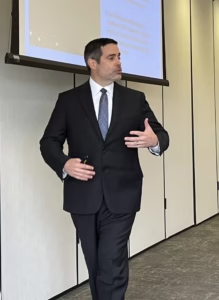
Estate planning makes a lot more sense when you can ask questions in real time.
Silverleaf Legal Group hosts free educational seminars throughout Central Texas and East Texas where attorney Tom Fortenberry walks through the fundamentals — wills, trusts, powers of attorney, probate, asset protection, and long-term care planning — in plain English, with no sales pressure and no obligation.
These aren’t sales events. They’re the same education-first approach that shapes every client relationship at Silverleaf. Come learn, ask questions, and leave with a clearer picture of where you stand.