
Estate Planning Services
Wills and trusts are legal documents that determine what happens to your assets when you pass away and who makes decisions on your behalf if you become incapacitated.
A will is a document that:
A trust is a legal arrangement that:
Our six step process focuses on education first, then documentation that matches your specific family situation and goals.
We start by learning about your family structure, assets, and concerns. Blended families have different needs than traditional families. Business owners need different protections than retirees. We take time to understand what matters to you.
We walk you through the differences between wills and trusts in plain English. You’ll understand how each tool works, when probate can be avoided, and what level of asset protection different structures provide. No legal jargon, no pressure just clear explanations.
Based on your goals, we recommend the right combination of documents. This might include:
We prepare all documents with Texas-specific language and legal requirements. You’ll review everything before signing, and we’ll make sure you understand what each document does.
If you’re using a trust, we help transfer assets into it, real estate, business interests, investment accounts, and other property. This step is critical because assets not properly titled in the trust may still go through probate.
Life changes. We encourage clients to review their plans when major events occur. Marriages, divorces, births, deaths, business changes, or significant asset acquisitions.
For many Texas families, a will is a reasonable starting point. It names who gets what, appoints an executor to carry out those wishes, and when properly drafted allows the estate to move through Texas probate efficiently. If your family situation is straightforward, your assets are relatively simple, and your main goal is directing where things go after you’re gone, a will can accomplish that.
But a will has limits. It distributes assets and steps aside. Once the executor carries out its instructions, the will’s job is done — and everything passes directly into the hands of whoever received it, with no conditions, no protection, and no ongoing structure.
A trust tends to be the better fit when one or more of the following apply:
Minor children are involved. A will can name a guardian for your children, but it cannot control how or when they receive assets. Without a trust, a minor who inherits money may receive the full amount at age 18 with no restrictions. A trust allows parents to structure distributions over time and for specific purposes.
The family is blended. When spouses have children from prior relationships, a will alone can create unintended co-ownership situations and title complications that are difficult and expensive to untangle. A trust gives families more precise control over how assets move between generations.
Avoiding probate is a priority. A will must go through the Texas probate process before it can do anything. A properly funded trust passes assets to beneficiaries without court involvement. For families who want a smoother, more private transition, that distinction matters.
Asset protection is a concern. A will distributes assets outright, leaving them exposed to a beneficiary’s creditors, divorce proceedings, or financial instability. A trust can hold assets for a beneficiary’s benefit while limiting exposure to those risks.
A beneficiary has special needs. Leaving assets directly to someone who receives SSI or Medicaid can disrupt their government benefits. A properly structured special needs trust allows families to provide supplemental support without affecting eligibility.
Neither option is universally better. The right structure depends on what a family is trying to accomplish — and many plans use both, with a trust as the primary vehicle and a will as a backup.
Texas law determines who inherits your assets through intestate succession rules. Your spouse may not get everything. Children from any relationship may inherit portions of your estate. The court appoints an administrator, and your estate goes through dependent probate, which is more expensive and time-consuming than independent probate.
If you create a revocable living trust, yes you can modify or revoke it at any time while you’re alive and have legal capacity. Once you pass away, the trust typically becomes irrevocable for your beneficiaries.
Independent probate in Williamson County typically costs around $5,000 to $6,000 and takes four to eight months. Dependent probate can cost $15,000 to $20,000 or more and may take two to three years. Costs vary based on estate complexity and whether family disputes arise.
A revocable trust allows you to maintain complete control. You can change it, sell assets, or dissolve it entirely. You’re still the owner for tax purposes. An irrevocable trust removes assets from your estate, which can provide asset protection and Medicaid planning benefits, but you give up direct control.
Not usually. Married couples in Texas typically use a single joint revocable trust that both spouses control together. When one spouse passes away, the trust continues for the survivor. Separate trusts may be appropriate for blended families or specific asset protection situations.
In most cases, no court proceeding is required if your trust is properly funded. The successor trustee you named can distribute assets according to the trust terms without probate. However, families sometimes consult an attorney to ensure they’re following the trust correctly.
Consider these factors: Do you want to avoid probate? Do you have minor children or beneficiaries who shouldn’t receive assets immediately? Are you concerned about asset protection from lawsuits, creditors, or divorce? Do you have a blended family? Is privacy important to you? We help you evaluate these questions based on your specific situation.
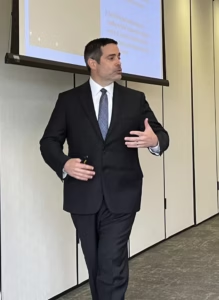
Estate planning makes a lot more sense when you can ask questions in real time.
Silverleaf Legal Group hosts free educational seminars throughout Central Texas and East Texas where attorney Tom Fortenberry walks through the fundamentals — wills, trusts, powers of attorney, probate, asset protection, and long-term care planning — in plain English, with no sales pressure and no obligation.
These aren’t sales events. They’re the same education-first approach that shapes every client relationship at Silverleaf. Come learn, ask questions, and leave with a clearer picture of where you stand.